In Sandboxels, creating humans is an element lookup and palette selection process rather than a multi-ingredient crafting recipe. You do not synthesize people by combining dirt, water, or meat; instead, you select the Human element directly from the Life category and spawn them into your sandbox world to test behaviors, hazards, and social interactions.
✓
Short answer: How to make humans in Sandboxels
Open the element palette, navigate to the Life category (or type 'human' into the search bar), select the Human element, and click or drag across a clean area of your canvas. Humans are ready-to-use living entities that spawn immediately upon placement without requiring pre-mixed recipes or incubation steps.
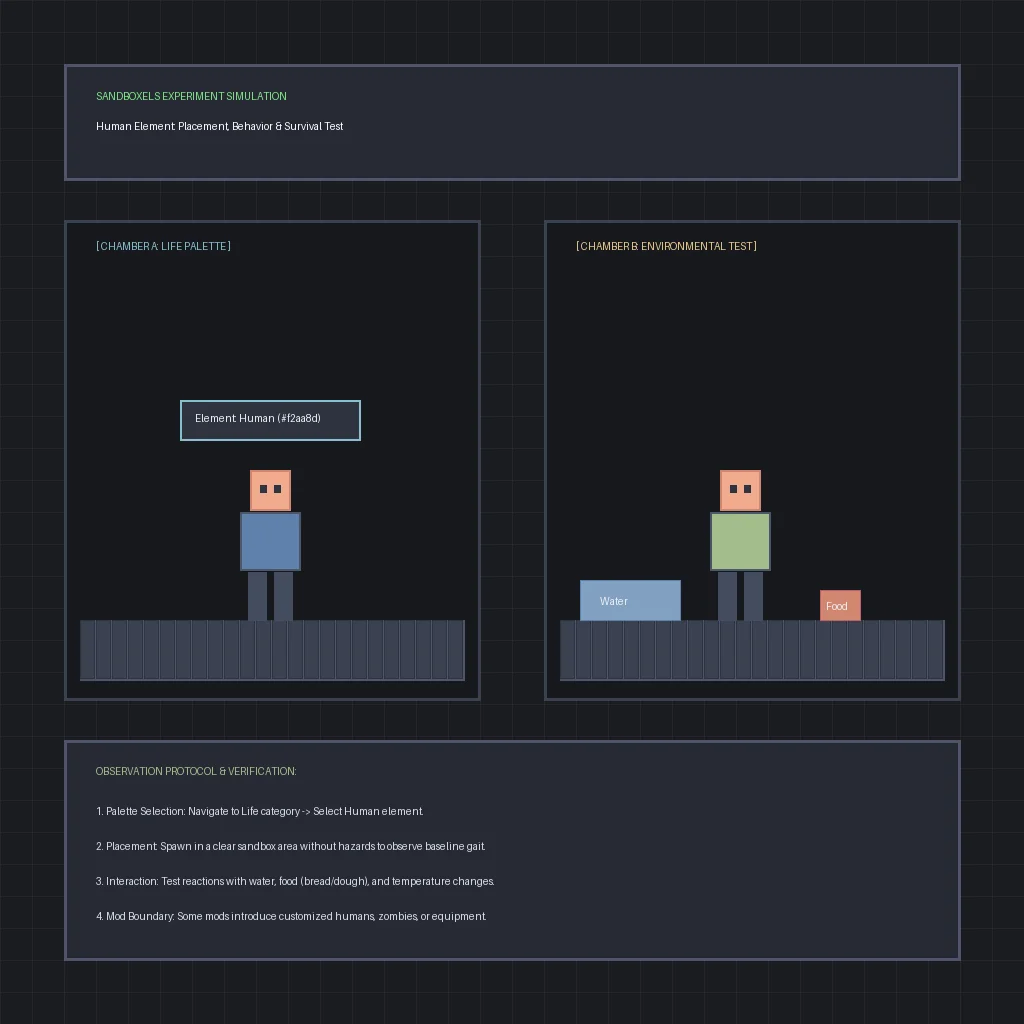
Editorial guide illustration: spawning the Human element in a clean chamber and observing environmental survival responses.STEP-BY-STEP SPAWN GUIDE
Finding and spawning humans in Sandboxels
1
Prepare an unobstructed test canvas
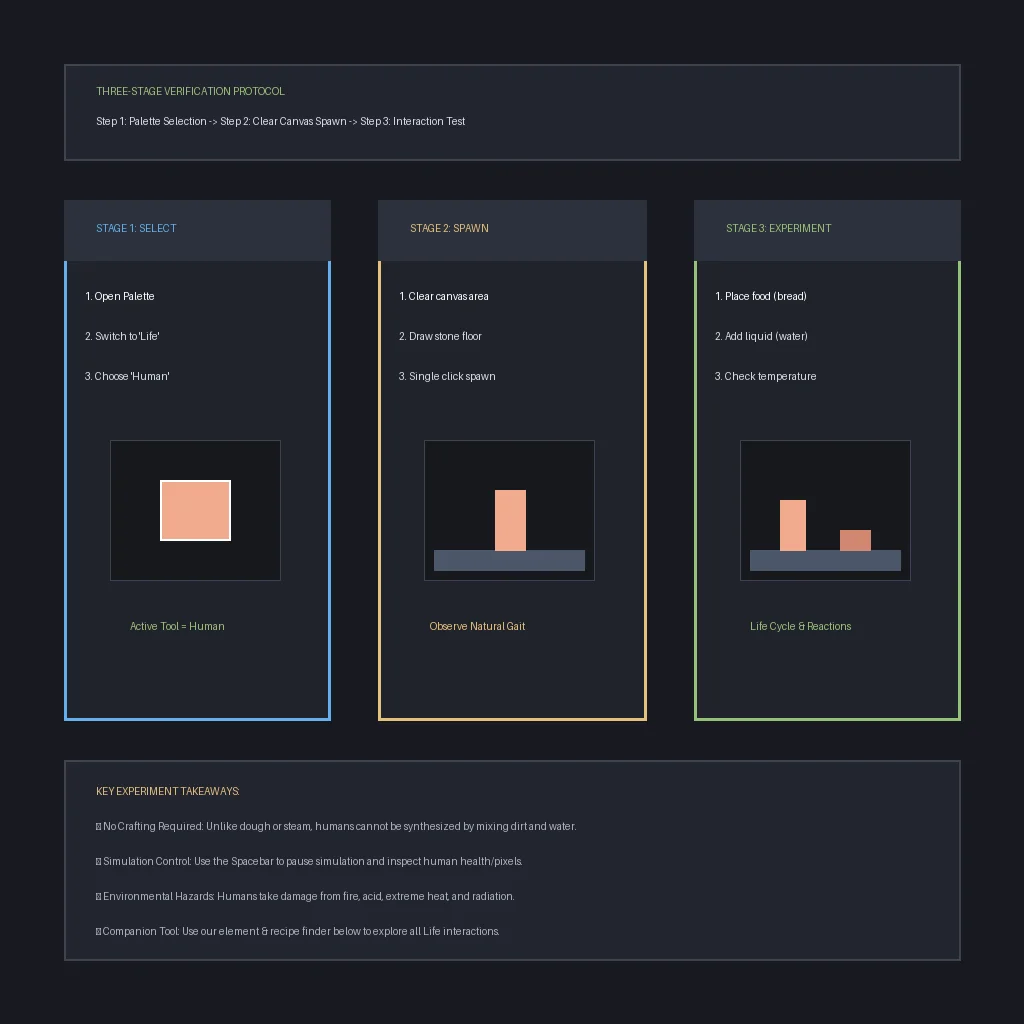
Start in an empty simulation area or create a fresh canvas using the clear command. Lay down a solid floor—such as stone, dirt, or wood—so the spawned human entities have a stable platform to stand and walk on without falling into the void or touching hazardous substances.
2
Access the Life category in the palette
Open the element selector bar at the top or side of the screen and switch to the Life category. If your interface features a quick-filter or search box, simply type 'human' or 'people' to jump directly to the human swatch.
3
Select the Human element swatch
Click or tap the Human swatch (identified by its peach/flesh-toned pixel color #f2aa8d). Ensure your active brush or tool displays 'Human' before drawing on the canvas to avoid placing the wrong living creature.
4
Spawn and observe movement
Click once on your platform to spawn an individual person, or drag the cursor to create a small group. Unpause the simulation (Spacebar) to watch them walk, step over small obstacles, and react to surrounding terrain.
Palette navigation: the Human element is located under the Life category or found instantly via the search bar.
Key boundary: Humans are spawned elements, not chemical reactions
Many new players wonder how to make humans in Sandboxels by searching for chemical or biological recipes involving water, soil, electricity, and meat. In the standard game, there is no crafting chain that converts inanimate ingredients into a living human. The proper method is direct palette placement. Attempting to force a recipe without the Life element will only yield inert organic sludge or fire hazards.
ELEMENT MECHANICS & EXPERIMENTS
Understanding human behavior, survival, and interactions in Sandboxels
When players ask how to make humans in Sandboxels, they often expect an intricate alchemical procedure similar to baking bread or cultivating bacteria. In the falling-sand universe of Sandboxels, however, life entities exist as first-class brush elements. Knowing how to place them quickly and safely is the foundational skill needed for running complex behavioral simulations, building cities, or orchestrating civilization experiments.
The primary prerequisite for a successful human experiment is environmental stability. Humans are mobile solid entities subject to gravity, temperature thresholds, and physical hazards. If you spawn humans in an active volcano chamber or an acidic swamp, they will expire before you can observe their gait or social tendencies. Laying down level bedrock or treated lumber ensures your subjects remain intact for ongoing observation.
Movement in Sandboxels is simulated through rule-based cellular automata. Once spawned, humans will wander horizontally across flat surfaces, climb single-pixel inclines, and turn around when encountering steep walls or impassable barriers. By constructing simple staircases, enclosures, and rooms, you can study how human pathfinding navigates varied structural layouts.
Nutritional and survival mechanics add another layer of depth to Sandboxels. Humans can interact with food elements such as dough, bread, cheese, and cooked meat. When placed near edible items, humans can consume them, which may restore health or trigger specific status behaviors depending on the active game version. Providing a steady food supply in a controlled habitat allows for prolonged survival trials.
Conversely, human vulnerabilities are extensive and realistic. Extreme temperatures will swiftly incapacitate human pixels: open flames cause immediate burning, while cryogenic gasses or liquid nitrogen will freeze them solid. Acid, venom, radiation, and electricity disrupt their pixel cohesion within seconds. Understanding these hazards allows experimenters to engineer functional protective shelters and hazard-containment facilities.
Water interaction is a frequent topic of community discussion. While humans can walk through shallow puddles without issue, submerging them completely in deep water reservoirs will eventually cause drowning if they cannot reach an air pocket or dry land. Testing buoyancy and oxygen deprivation offers fascinating insights into how the game balances aquatic and terrestrial life.
Social density and population dynamics also yield interesting sandbox phenomena. Spawning dozens of humans within a confined chamber creates crowded movement patterns where entities push past one another and seek open space. Adding tools, building materials, or interactive props can simulate rudimentary communal activities and territorial clustering.
Advanced players often combine humans with automation and machinery. Using conductive wires, pressure sensors, and mechanical gates, you can design automated airlocks, feeding dispensers, and elevators triggered by human movement. These contraptions transform a simple sandbox into a reactive, living machine environment.
Modded Sandboxels gameplay expands human capabilities even further. Community mods frequently introduce specialized human professions, uniforms, custom equipment, and fantasy variants such as wizards, cyborgs, or zombies. When exploring modded environments, always verify whether new human variants require specific mod loader scripts or custom palette tabs before testing.
To document your findings systematically, maintain a clean testing protocol: note the game version, active mods, surrounding temperature, floor composition, and nearby food or hazard sources. Comparing controlled trials against chaotic setups will help you master the subtle mechanics governing life in pixel physics.
Our companion element and recipe finder below provides an immediate reference for checking the exact properties of the Human element, its category hierarchy, and its known interactions with other materials. Use it to look up thermal limits, related lifeforms, and survival variables before staging your next experiment.
In summary, mastering how to make humans in Sandboxels is about understanding palette deployment and environmental stewardship. Spawn them from the Life tab onto stable foundations, provide food and shelter, protect them from extreme elements, and explore the rich emergent behaviors that make Sandboxels an exceptional pixel sandbox.
Three-stage verification workflow: select the swatch, place entities on a clear floor, and test food or temperature interactions.
ELEMENT LOOKUP
Find Human in the element catalog
Inspect the Human element in our companion tool below to review its category, color code (#f2aa8d), state of matter, and related environmental reactions.
Pick an element, then click or drag on the canvas.Sandboxels-style pixel experiment canvas
Find a Sandboxels reaction
Choose two elements to see a concise combination note, conditions and a next step.
+
+
?
Choose two elements
The tool will show a result, condition and related guide here.
Search the element catalog
Filter the starter catalog by name, category or state. Use a result to load it into the experiment.
⌕
HUMANS FAQ
Frequently asked questions about humans in Sandboxels
Can you craft or combine ingredients to create humans in Sandboxels?
No. In vanilla Sandboxels, humans cannot be synthesized by mixing other elements like dirt, water, meat, or electricity. They are placed directly from the Life category in the element palette.
Where do I find the Human element in the Sandboxels menu?
Click the Life category tab in the palette, or use the search field and type 'human'. The swatch displays a flesh-toned pixel color (#f2aa8d).
What do humans eat in Sandboxels?
Humans will interact with and consume various food items placed in their path, including dough, bread, flour products, cheese, and cooked meat, depending on the active game version.
Why do my humans keep disappearing or dying immediately?
Check your ambient temperature and surface materials. Humans take rapid damage from fire, acid, lava, radiation, extreme cold, and deep unbreathable water. Ensure you spawn them on a neutral solid surface at moderate temperatures.
AUTHORITATIVE REFERENCES
Official references for Sandboxels life elements
↗
Sandboxels Wiki: Human
Consult the official community wiki for detailed documentation on human entity states, health mechanics, and element classifications.